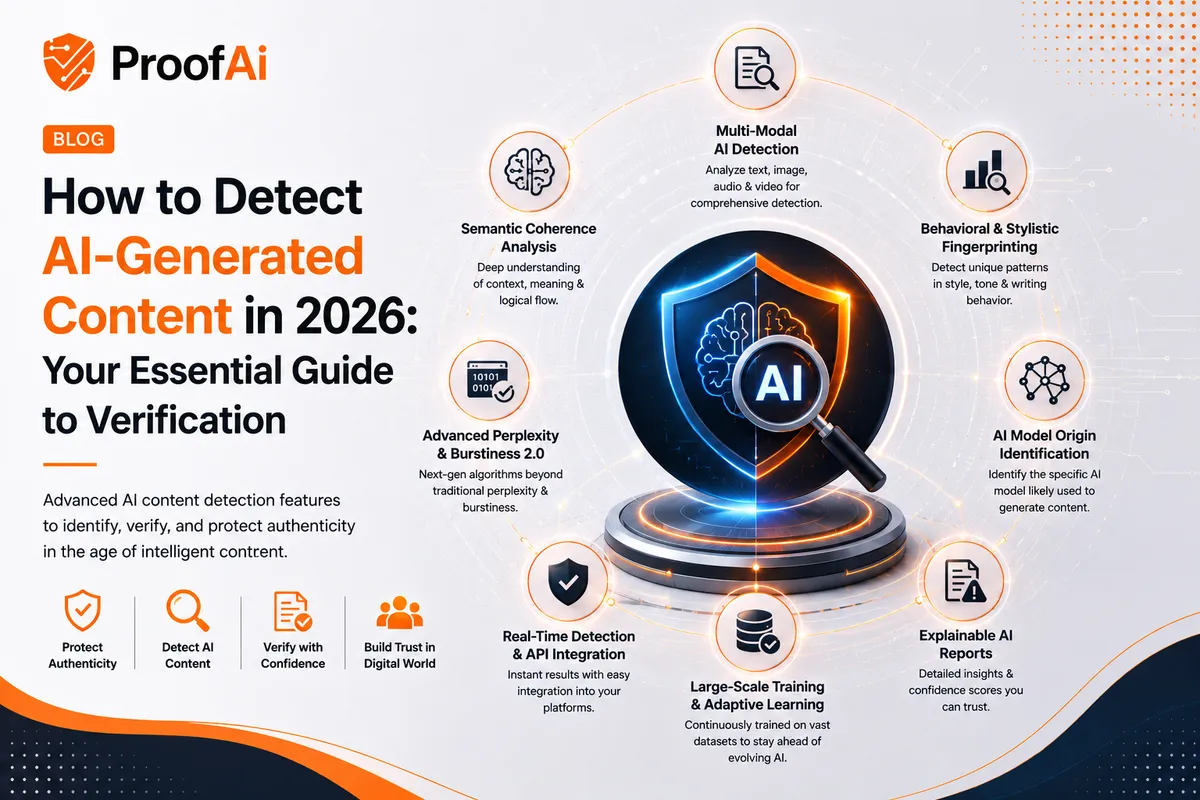
How to Detect AI-Generated Content in 2026
What actually works for spotting AI-generated content in 2026: detectors, watermarks, provenance data and human review, with their limits explained.
There is no single test that tells you whether content was made by AI. There are several methods, each with clear strengths and limits. Used together, with a person making the final call, they give you a reasonable picture.
This guide covers the four main approaches, what research and official documentation say about each, and a simple workflow for writers, publishers, educators and businesses.
Try it: use ProofAI's AI detector tool, free for 10 checks a day with no login.
Method 1: Human review
People are the final judges, but not good detectors. In a 2021 ACL study, non-experts separated GPT-3 text from human text at "random chance level" (Clark et al.). A 2023 PNAS study with 4,600 participants found people relied on cues such as first-person pronouns and contractions, which AI can easily copy (Jakesch, Hancock and Naaman).
Where human review does help is checking substance:
- Facts and sources. Fabricated references and confident errors are verifiable. Google's own guidance notes that generative models can produce hallucinations and says "it is critical to manually factcheck and review all AI-generated content" before publishing (Google Search Central).
- Specificity. Does the piece contain first-hand detail, real examples and claims the author can explain?
- Context. Does it answer the actual brief, or a more generic version of it?
Method 2: AI detection software
Detectors are classifiers trained to estimate how likely a text is to be machine-written. They give a probability, not a fact.
Want to check your own content? Try ProofAI free 10 checks a day, no login needed.
Their limits are well documented:
- OpenAI's own classifier flagged 26% of AI-written text in testing, mislabelled human text 9% of the time, was "very unreliable" below 1,000 characters, and was withdrawn on 20 July 2023 "due to its low rate of accuracy" (OpenAI).
- A Stanford study by Liang et al. found seven detectors falsely flagged TOEFL essays by Chinese students at an average rate of 61.3%. Prompting ChatGPT to use more literary language pushed detection close to zero (Times Higher Education).
- OpenAI's guidance for educators says small edits can help text evade detectors (OpenAI Help Center).
Detectors are most useful when they show which passages drove the score, so a person can read and judge those parts. ProofAI's Detection Hub checks text, documents and images, and its main detector shows the passages behind a score. Like any detector, its results are probabilities, not proof.
Also read: How Teachers Can Detect ChatGPT in Assignments, Fairly
Method 3: Watermarks
A watermark is a hidden signal added when the content is generated. Google DeepMind's SynthID adds one to text by "modulating the likelihood of tokens being generated", and a detector then looks for that statistical pattern (Google DeepMind).
Google is open about the limits. SynthID text watermarking is "less effective on responses to factual prompts", and its confidence "can be greatly reduced" when text is thoroughly rewritten or translated. Google says it "isn't a silver bullet".
The bigger practical limit is coverage. A watermark only helps if the tool that generated the content added one and you have a way to check it. The absence of a watermark tells you nothing.
Method 4: Provenance data
Provenance records how a file was created and edited. The C2PA standard, behind "Content Credentials", stores this as a manifest that is cryptographically signed, covering assertions about creation, edits and capture device (C2PA specification).
The specification is careful about what this proves. Validation asks whether the assertions "can be validated as associated with the underlying asset" and have not been tampered with. It does not judge whether the content is true. Missing provenance is also common, since many tools and platforms do not add or keep it.
Google now asks ecommerce sites to include IPTC DigitalSourceType metadata on AI-generated images and to label AI-generated product titles and descriptions (Google Search Central).
A practical workflow
- Set your rule first. Decide what AI use is acceptable in your setting. Google's guidance, for example, does not ban AI content. It warns that using it to generate many pages without adding value for users may break its spam policy on scaled content abuse.
- Check provenance and metadata where available, especially for images.
- Run a detector on longer samples and read the flagged passages yourself.
- Verify facts, quotes and references. This is often the strongest evidence you will find.
- Ask the author. Drafts, notes, version history or a short conversation usually settle the question.
- Decide with a person in charge. Record what you checked, and never act on a single score.
What this means for different readers
- Writers and agencies: keep drafts and notes, cite sources, and fact-check anything an AI tool helped produce. This protects you if your work is ever wrongly flagged.
- Publishers: say how AI was used in your content where readers would expect to know, as Google's guidance suggests.
- Educators and recruiters: focus on verifiable evidence and conversation. Be especially careful with second-language writers, who face higher false-flag risk.
- Developers: if you add detection to a platform, route high scores to human review rather than blocking content automatically.
The bottom line
In 2026, detecting AI content is about combining imperfect signals: detector scores, watermarks, provenance data and human checks of facts and context. None is reliable alone. The fairest results come from treating every signal as evidence to weigh, with a person making the final decision.
Sources
- Clark, E. et al. (2021). All That's 'Human' Is Not Gold: Evaluating Human Evaluation of Generated Text. ACL 2021. https://aclanthology.org/2021.acl-long.565
- Jakesch, M., Hancock, J. and Naaman, M. (2023). Human heuristics for AI-generated language are flawed. PNAS. https://arxiv.org/abs/2206.07271v4
- Google Search Central. Google Search's guidance on using generative AI content on your website (last updated 1 Oct 2026). https://developers.google.com/search/docs/fundamentals/using-gen-ai-content
- OpenAI. New AI classifier for indicating AI-written text (updated July 2023). https://openai.com/index/new-ai-classifier-for-indicating-ai-written-text/
- Times Higher Education (11 July 2023). AI text detectors 'biased against non-native English speakers'. https://www.timeshighereducation.com/node/727071
- OpenAI Help Center. How can educators respond to students presenting AI-generated content as their own? https://help.openai.com/en/articles/8313351-how-can-educators-respond-to-students-presenting-ai-generated-content-as-their-own
- Google DeepMind (14 May 2024). Watermarking AI-generated text and video with SynthID. https://deepmind.google/blog/watermarking-ai-generated-text-and-video-with-synthid/
- C2PA. Content Credentials: C2PA Technical Specification 2.2. https://spec.c2pa.org/specifications/specifications/2.2/specs/C2PA_Specification.html
Written and reviewed by the 4Born Content Writer Team. AI tools assisted with drafting; every statistic above links to its source.
Published by
AI tools may assist with drafting; a team member checks and approves every article before it is published. How we write and correct articles.
Popular AI detection tools
Ready to Verify Your Content?
Get weekly insights on AI detection. Start your journey toward digital authenticity with our AI detection tools.