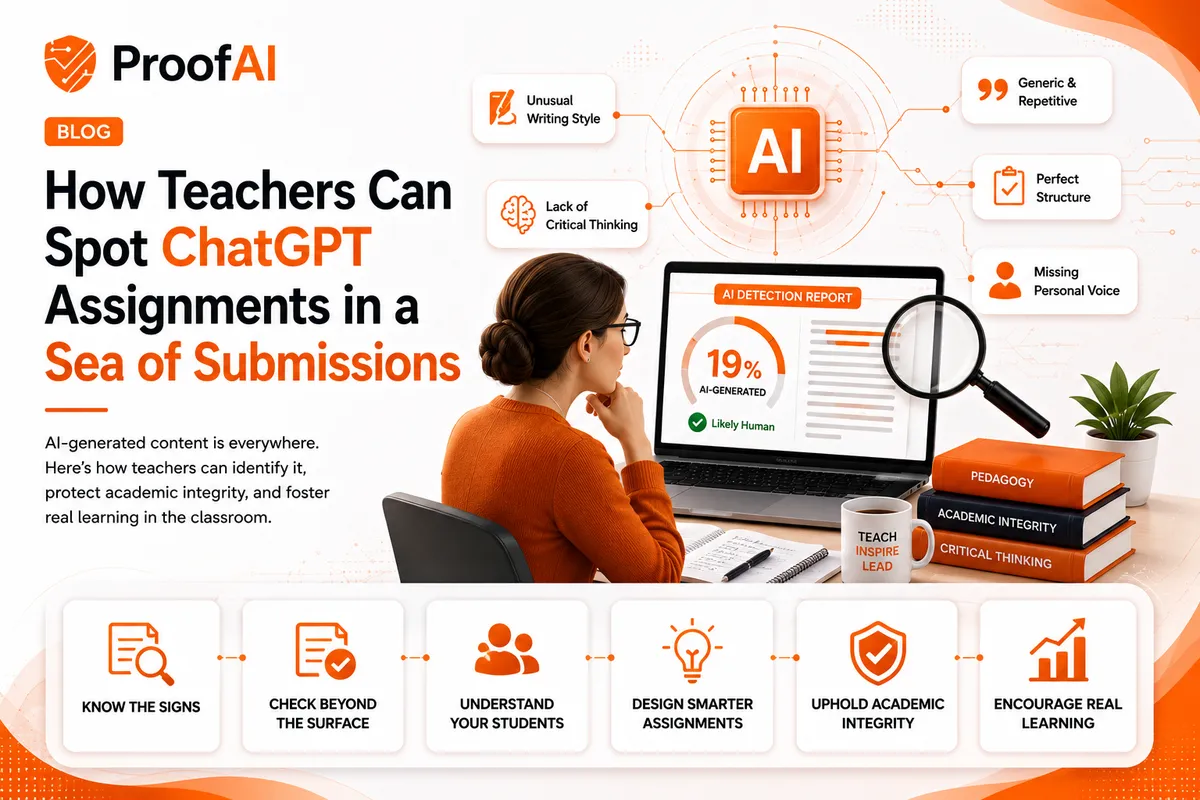
How Teachers Can Detect ChatGPT in Assignments, Fairly
A practical guide for teachers: why AI detector scores are not proof, what evidence to look for, and how to design assignments that show real learning.
When an essay reads too smoothly, it is tempting to paste it into a detector and act on the number. That is the step most likely to go wrong. Detector scores can be useful, but on their own they have led to students being wrongly suspected.
This guide covers what the evidence says about detection, what to look for in a student's work, how to handle a suspicion, and how to set assignments where AI shortcuts matter less.
Try it: use ProofAI's ChatGPT checker, free for 10 checks a day with no login.
What the evidence says about AI detectors
Three findings are worth knowing before you rely on any tool.
- OpenAI withdrew its own detector. OpenAI's AI text classifier correctly flagged 26% of AI-written text in its own test and mislabelled human text 9% of the time. It was withdrawn on 20 July 2023 "due to its low rate of accuracy" (OpenAI).
- Non-native English writers are flagged more often. Liang et al. at Stanford tested seven detectors on 91 TOEFL essays by Chinese students. The average false-positive rate was 61.3%, while essays by US eighth-graders were classified correctly. The authors warned that non-native students "bear more risks of false accusations of cheating" (Times Higher Education).
- Small error rates still hit real students. Vanderbilt University disabled Turnitin's AI detector in August 2023. Turnitin claimed a 1% false-positive rate. Vanderbilt estimated that, applied to the 75,000 papers it submitted in 2022, that could mean about 750 papers wrongly flagged (Vanderbilt University).
OpenAI's guidance for educators adds two more points. OpenAI says its own detector labelled human-written text such as Shakespeare and the Declaration of Independence as AI-generated, and asking ChatGPT "did you write this?" produces answers that are "random and have no basis in fact" (OpenAI Help Center).
Your own judgement is not a perfect check either. In one study, 72 reviewers from applied linguistics journals identified AI versus human research abstracts correctly only 38.9% of the time (Casal and Kessler, 2023).
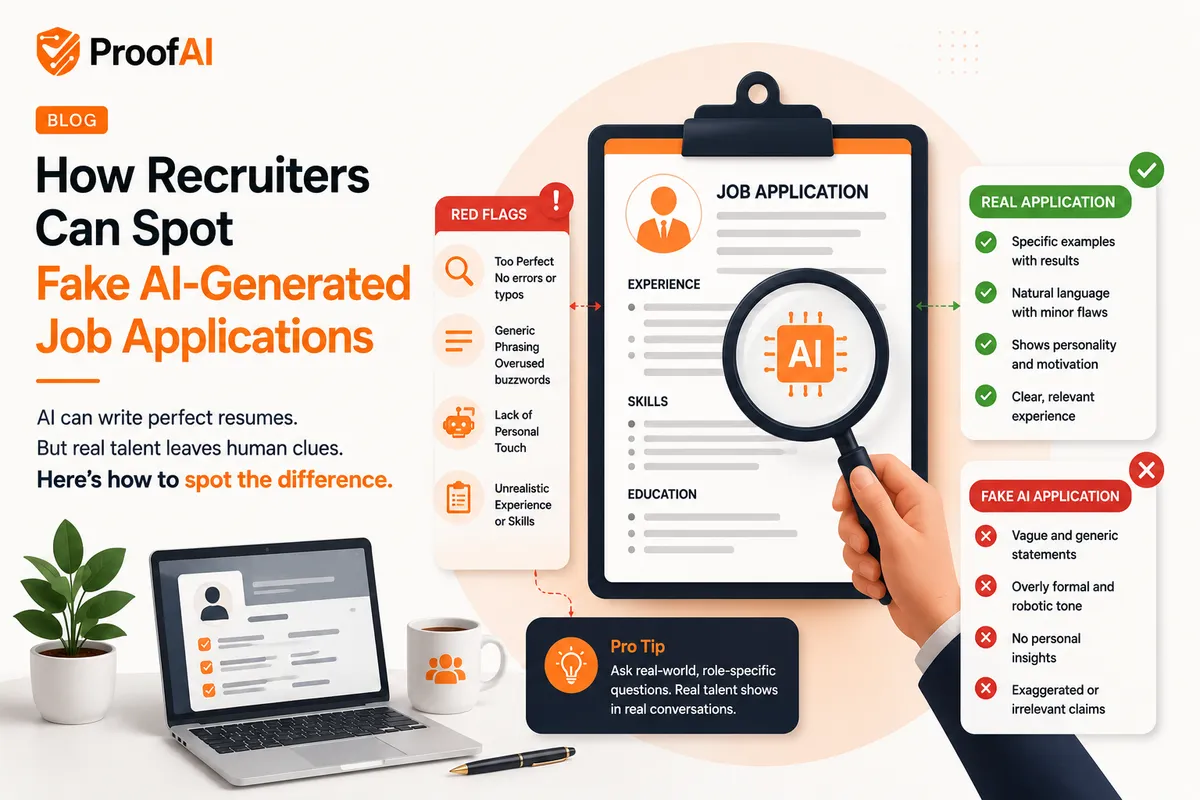
Also read: How to Detect AI-Written Resumes and Job Applications
What to look for in the work itself
These signs are reasons to look closer and talk to the student. None is proof on its own.
Want to check your own content? Try ProofAI free 10 checks a day, no login needed.
- A sharp change from the student's usual work. Compare with in-class writing, earlier drafts and short exercises. A jump in vocabulary or structure can have innocent causes, such as tutoring or a grammar tool, so ask rather than assume.
- Facts and sources that do not check out. Invented quotations, references that do not exist, or confident but wrong claims are concrete and verifiable. Check every citation in a suspect paper.
- No link to your course. An essay that ignores the set reading, class discussion or the specific prompt, and instead answers a more general question.
- Generic content. Broad statements with no examples, where the assignment asked for a personal view or a local case.
- Missing process. No notes, outline or draft history when the task required them.
How to handle a suspicion
- Check your institution's policy first. Know what AI use is allowed and what process to follow before you raise it.
- Gather evidence beyond a score. Note the specific passages, unverifiable sources and comparison samples that concern you.
- Have a conversation, not an accusation. Ask the student to talk you through their argument, explain a key source, or describe how they wrote the piece. A student who did the work can usually do this.
- Ask for process evidence. Drafts, notes and document version history are useful. If AI use is permitted with disclosure, OpenAI suggests students can share their ChatGPT conversations so you can see how they used it.
- Use a detector, if at all, as one input. Choose a tool that shows which passages it flagged so you can read them, and test longer samples, since short texts are less reliable.
- Record your reasoning. Write down what you checked and why. Never base a penalty on a detector score alone.
If you use ProofAI's essay detector as one of those inputs, treat its result as a probability, not proof.
Design assignments where AI shortcuts matter less
Detection after the fact is hard. Assignment design is often more effective.
- Make the process part of the grade. Ask for a proposal, an outline, a draft and a short reflection. Each stage gives you a baseline and a conversation point.
- Include some in-class writing. Short timed responses give you a sample of each student's own voice.
- Tie prompts to your course. Require specific readings, class discussions, local data or the student's own experience.
- Add a short oral check. A five-minute conversation about a submitted piece reveals understanding quickly.
- Set a clear AI policy. Tell students what is allowed, such as brainstorming or grammar help, and how to disclose it. Clear rules reduce both misuse and false suspicion.
The bottom line
No tool or instinct reliably identifies AI writing, and the cost of a false accusation falls on the student. Focus on evidence you can verify, talk to students about their work, and design tasks that show learning. Use detectors, if you use them, to decide what to look at more closely, not to decide the outcome.
Sources
- OpenAI. New AI classifier for indicating AI-written text (updated July 2023). https://openai.com/index/new-ai-classifier-for-indicating-ai-written-text/
- Times Higher Education (11 July 2023). AI text detectors 'biased against non-native English speakers'. https://www.timeshighereducation.com/node/727071
- Vanderbilt University (16 Aug 2023). Guidance on AI detection and why we're disabling Turnitin's AI detector. https://www.vanderbilt.edu/brightspace/2023/08/16/guidance-on-ai-detection-and-why-were-disabling-turnitins-ai-detector/
- OpenAI Help Center. How can educators respond to students presenting AI-generated content as their own? https://help.openai.com/en/articles/8313351-how-can-educators-respond-to-students-presenting-ai-generated-content-as-their-own
- Casal, J. E. and Kessler, M. (2023). Can linguists distinguish between ChatGPT/AI and human writing? Research Methods in Applied Linguistics. https://digitalcommons.memphis.edu/facpub2/10
Written and reviewed by the 4Born Content Writer Team. AI tools assisted with drafting; every statistic above links to its source.
Published by
AI tools may assist with drafting; a team member checks and approves every article before it is published. How we write and correct articles.
Popular AI detection tools
Ready to Verify Your Content?
Get weekly insights on AI detection. Start your journey toward digital authenticity with our AI detection tools.