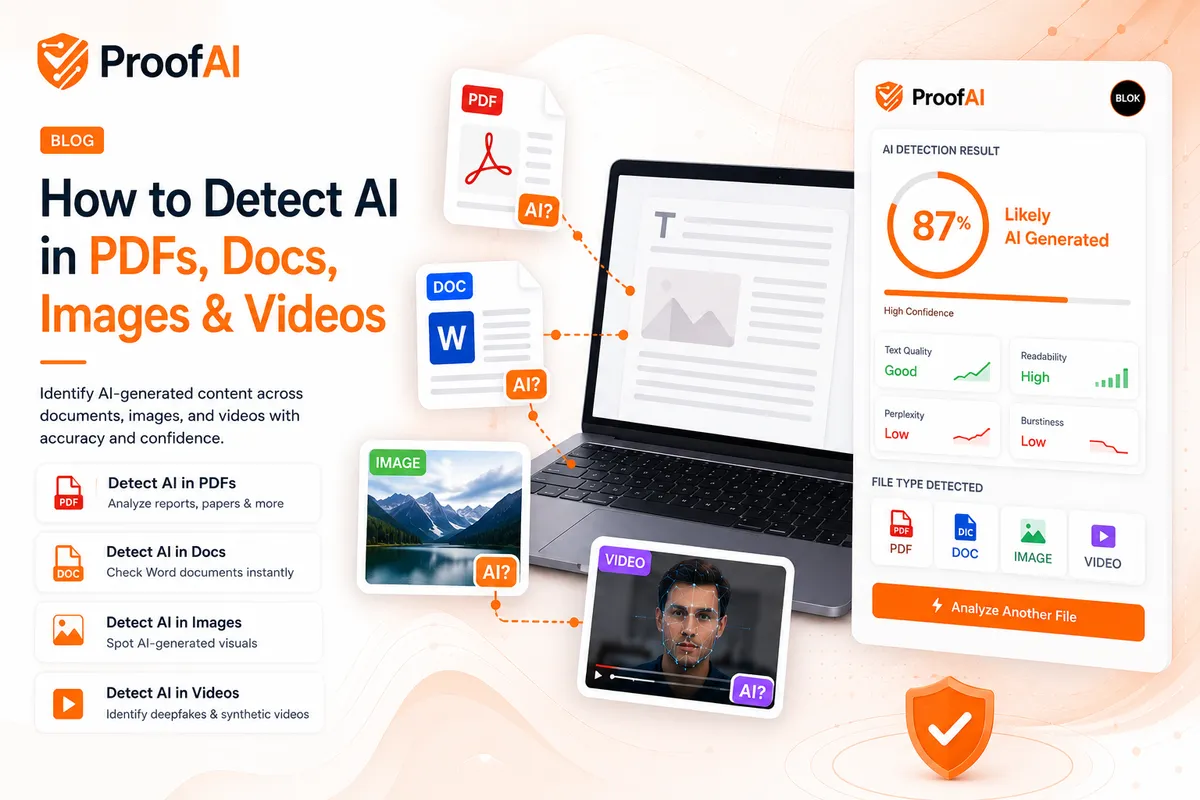
How to Detect AI in PDFs, Docs, Images and Videos
Practical checks for AI-generated PDFs, Word files, images and videos: what tools can do, what provenance data shows, and what still needs a human.
AI-generated content now arrives in every format: a report as a PDF, an assignment as a Word file, a product photo, a video clip. Each format needs a slightly different approach, and for some there is no reliable automated answer yet.
This guide sets out what you can check in each case, and where you need human judgment.
Try it: use ProofAI's PDF AI checker, free for 10 checks a day with no login.
Three rules that apply to every format
- A detector score is a probability, not proof. Turnitin, for example, says its AI score "should not be used as the sole basis for action" (Turnitin FAQ).
- Missing metadata proves nothing. Metadata is easily stripped by screenshots, re-saves and messaging apps.
- Verifiable facts beat style. A fake citation, an impossible shadow or a wrong date is stronger evidence than "it feels generated."
PDFs and Word documents
For documents, you are usually checking the text inside them.
Want to check your own content? Try ProofAI free 10 checks a day, no login needed.
Run the text through a detector. Most text detectors accept a file upload or pasted text. Make sure there is enough text: OpenAI described its own classifier as "very unreliable" on texts below 1,000 characters (OpenAI), and Turnitin requires at least 300 words of prose for an English AI report (Turnitin FAQ).
Check the extraction. Scanned PDFs may contain images of text rather than text. If the detector cannot read the words, its result means nothing. Copy a paragraph out of the file to confirm the text is selectable.
Strip out non-prose. Tables, references, code and headings can skew results. If the tool lets you, check the main body separately.
Verify the references. Look up every cited source. Generated documents can include convincing citations that do not exist, as two New York lawyers found when a judge fined them $5,000 in 2023 for filing a brief with six fake ChatGPT-generated cases (Bloomberg Law).
Look at document properties and history. In Word or Google Docs, version history can show whether text was written over time or pasted in one block. Author and software fields in file properties are weak evidence on their own, but can help.
Be careful with non-native writers. In a Stanford study, seven detectors misclassified essays by non-native English speakers as AI-generated at an average rate of 61.3% (Times Higher Education).
Also read: AI Hiring Fraud: Warning Signs at Every Hiring Stage
Images
Look for visual errors. Check hands, teeth, ears, jewellery and text in signs or labels. Look at edges where a subject meets the background, and at reflections and shadows. Newer models make fewer mistakes, so a clean image is not proof it is real.
Check for Content Credentials. The C2PA standard lets cameras and software attach a cryptographically signed record of an image's origin and edits, including use of AI (C2PA Explainer). Two limits matter: adding credentials is optional, so their absence does not mean an image is fake, and credentials "do not provide value judgments" about whether content is true.
Check for vendor watermarks. Google's SynthID embeds watermarks in content from its Gemini, Imagen, Lyria and Veo models. Google says over 10 billion pieces of content had been watermarked by May 2025, when it announced the SynthID Detector portal for early testers (Google). This only identifies content made with Google's tools.
Use an image detector as one input. Image detectors look for statistical patterns left by generators. Treat the result as you would a text score.
Reverse image search. Search for earlier copies of the image. A real news photo usually has a traceable origin; a generated one often has none.
Videos
Automated detection of AI video is less mature, and many tools, including ours, do not offer it yet. Most checks are manual.
Watch the face closely. MIT Media Lab's Detect Fakes project suggests checking whether skin looks too smooth or too wrinkled for the person's apparent age, whether shadows around the eyes and eyebrows fall naturally, whether glare on glasses shifts as the head moves, how often the person blinks, and whether lip movements match the speech (MIT Media Lab). It also warns there is "no single tell-tale sign."
Slow it down. Step through frame by frame around fast movements, hands and hair, where errors often show.
Check the source. Who posted it first? Is there an original upload, a longer version, or coverage from a reliable outlet? Provenance questions often settle a case faster than visual analysis.
Check for credentials and watermarks. See whether the file carries Content Credentials, with the same limits as for images. When Google announced the SynthID Detector in May 2025, it said video and text watermark detection would follow "in the coming weeks", so check Google's current documentation for what the detector supports today (Google).
Ask for corroboration. For anything high stakes, such as a payment request or a statement attributed to a public figure, confirm through a separate channel before acting.
A simple workflow for teams
- Identify the format and whether the text or image can be read by a tool.
- Run an automated check where one exists, and note the score.
- Do the manual checks above: facts, citations, visual errors, provenance.
- Compare with known genuine work from the same source.
- Record what evidence you relied on beyond the score.
Checking documents and images
ProofAI checks text, PDF, DOCX, DOC and TXT files, and JPG, PNG and WebP images up to 25 MB, and highlights the passages that drove a text score. It does not detect video yet, so use the manual video checks above. You can upload a file on the document detection page with 10 free checks a day.
Sources
- Turnitin, "AI writing detection capabilities FAQs": https://guides.turnitin.com/hc/en-us/articles/28477544839821-Turnitin-s-AI-writing-detection-capabilities-FAQs
- OpenAI, "New AI classifier for indicating AI-written text": https://openai.com/index/new-ai-classifier-for-indicating-ai-written-text/
- Bloomberg Law, "Phony ChatGPT Brief Leads to $5,000 Fine for NY Lawyers" (22 June 2023): https://news.bloomberglaw.com/bgov-labor/chatgpt-phony-legal-filing-case-gets-lawyers-a-5-000-fine
- Times Higher Education on Liang et al., Patterns (11 July 2023): https://www.timeshighereducation.com/node/727071
- C2PA and Content Credentials Explainer (v2.3): https://spec.c2pa.org/specifications/specifications/2.3/explainer/Explainer.html
- Google, "SynthID Detector — a new portal to help identify AI-generated content" (20 May 2025): https://blog.google/innovation-and-ai/products/google-synthid-ai-content-detector/
- MIT Media Lab, Detect Fakes project: https://www.media.mit.edu/projects/detect-fakes/overview/
Written and reviewed by the 4Born Content Writer Team. AI tools assisted with drafting; every statistic above links to its source.
Published by
AI tools may assist with drafting; a team member checks and approves every article before it is published. How we write and correct articles.
Popular AI detection tools
Ready to Verify Your Content?
Get weekly insights on AI detection. Start your journey toward digital authenticity with our AI detection tools.