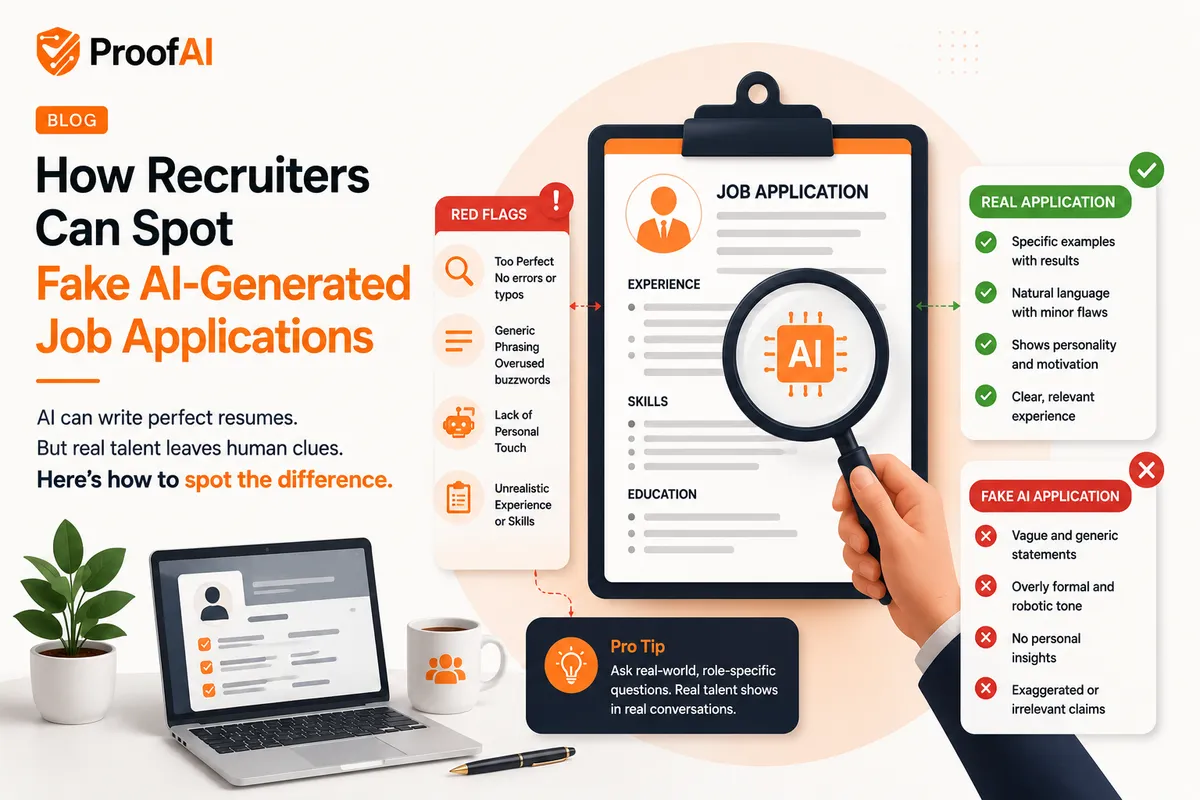
How to Screen AI-Written Job Applications Fairly
Most candidates now use AI on applications. A fair, practical way to screen AI-written CVs and cover letters without rejecting honest applicants.
AI use on job applications is now normal. In a Gartner survey of 3,290 candidates, 39% said they used AI during the application process, and HR Dive reports that this was mainly for CVs, cover letters, writing samples and assessment answers.
So "was this written with AI?" is the wrong question for most roles. The useful question is: does this application honestly represent what this person has done and can do? This guide covers how to screen for that, fairly.
Try it: use ProofAI's AI checker tool, free for 10 checks a day with no login.
Decide what you are screening for
Separate three situations before you look at a single CV:
- AI-polished. The candidate's real experience, rewritten for clarity or grammar. For most roles this is acceptable and comparable to using a template or asking a friend to proofread.
- AI-inflated. Real candidate, invented or exaggerated content: skills they lack, results they did not achieve.
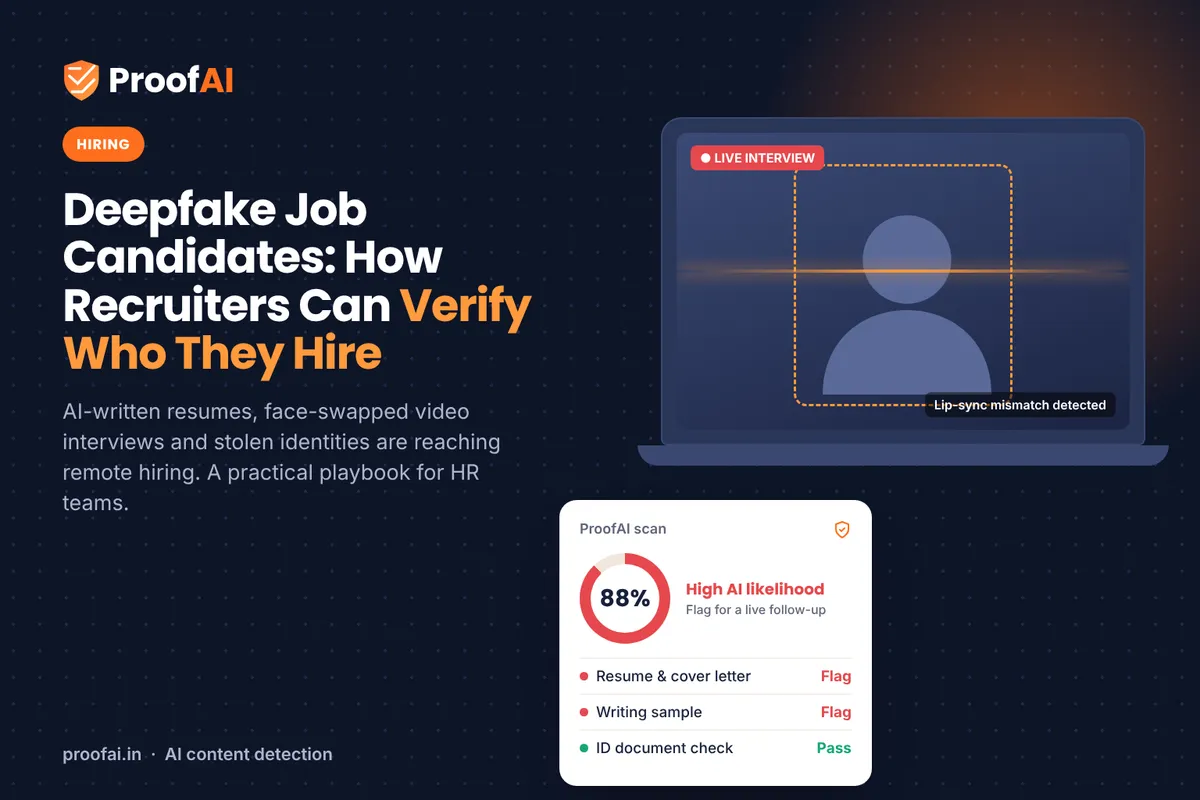
- Fabricated. The identity or work history is not real. This is identity fraud and needs verification steps, covered in our post on deepfake job candidates.
Your screening should target the second and third. Penalising the first mostly filters out people who used a common tool.
Tell candidates your rules up front
Gartner's first recommendation to employers is to set clear expectations about acceptable AI use and hiring standards. Add two or three lines to your job posts, for example:
Want to check your own content? Try ProofAI free 10 checks a day, no login needed.
You may use AI tools to help write your application. Everything in it must be accurate, and you should be ready to discuss any part of it in detail. Writing tasks during interviews are done without AI unless we say otherwise.
This is also about trust. The same Gartner survey found only 26% of candidates trust AI to evaluate them fairly.
Also read: Signs Content Was Written by ChatGPT (and Their Limits)
Signs an application may be inflated
These signals relate to substance, not style. Each is a reason to ask a question.
- Claims without specifics. "Drove significant growth" with no product, number, timeframe or team.
- Skills with no evidence. A long list of tools that never appear in the experience section.
- A cover letter that could go to any employer. No reference to your company, role or market.
- Mismatches. Dates, titles or employers that differ between the CV, the application form and the public profile.
- Seniority that does not fit. Senior-level claims in an early-career timeline.
Style signals are much weaker. Perfect grammar, formal tone and repeated sentence openings are common in AI text, but also in writing by careful people, by candidates using templates, and by people writing in a second language. Do not screen on style alone.
Using an AI detector responsibly
A detector can help you prioritise which applications to look at more closely. It cannot tell you whether a candidate is honest. Keep three facts in mind.
Detectors make mistakes. OpenAI withdrew its own AI text classifier in July 2023 because of its low rate of accuracy. It reported that the classifier was very unreliable on texts under 1,000 characters, which is the length of many cover letters and CV summaries.
False flags are not evenly spread. In a 2023 study, seven detectors wrongly flagged an average of 61.22% of essays written by non-native English speakers as AI-generated. The authors of the study warn against using detectors in evaluative settings where non-native speakers could be disadvantaged. For employers hiring across India and other multilingual markets, this matters a great deal.
Some places regulate automated hiring tools. In New York City, Local Law 144 covers tools that substantially assist or replace discretionary decision-making in hiring. Employers using them must have a bias audit within the past year and notify candidates 10 business days in advance. If you hire there, or in another jurisdiction with similar rules, take legal advice before letting any score influence a shortlist. Whether a standalone AI-text detector counts as an automated employment decision tool under such rules depends on how it is used, so ask a lawyer rather than assuming it does or does not.
The safe pattern is simple: a score decides which questions to ask, not who gets rejected.
A fair screening workflow
- Screen on job requirements first. Shortlist on qualifications and evidence, as you would without AI in the picture.
- Use detection as a note, not a filter. If you run a detector, record the result and which passages drove it. Do not remove anyone at this stage.
- Turn flags into interview questions. If a project description is vague or flagged, ask about it: what was your part, what went wrong, what would you change?
- Add one short live exercise. A short task tied to real work, done live, tells you more than any CV analysis.
- Verify a few key facts. Confirm one or two employers or qualifications through official contacts.
- Record the reason for every decision. The reason should be about skills or verified facts, never a detection score alone.
- Apply the same steps to everyone. Same checks, same questions, same threshold for each candidate for a role.
Screening at volume
For a single CV or cover letter, ProofAI's AI resume checker accepts PDF, DOCX, DOC or TXT files up to 25 MB and highlights the passages behind each score. ProofAI also has a REST API for text detection that developers can build into their own tools. Today each API call checks one piece of content, and batch processing is planned, so contact ProofAI if you need high volumes. ProofAI's results are probabilities, so use them in step 2 above and never reject a candidate on a score alone.
ProofAI sends the text or files you check to AI model providers to analyse them and keeps a record of each check (date, type and score, never your content); see our privacy policy.
Sources
- Gartner, Survey Shows Just 26% of Job Applicants Trust AI Will Fairly Evaluate Them (31 July 2025)
- HR Dive, Fake job candidates and AI (8 August 2025)
- OpenAI, New AI classifier for indicating AI-written text (update of 20 July 2023)
- Liang, W. et al., GPT detectors are biased against non-native English writers, Patterns, 2023 (full text)
- NYC Department of Consumer and Worker Protection, Automated Employment Decision Tools: Frequently Asked Questions
Written and reviewed by the 4Born Content Writer Team. AI tools assisted with drafting; every statistic above links to its source.
Published by
AI tools may assist with drafting; a team member checks and approves every article before it is published. How we write and correct articles.
Popular AI detection tools
Ready to Verify Your Content?
Get weekly insights on AI detection. Start your journey toward digital authenticity with our AI detection tools.