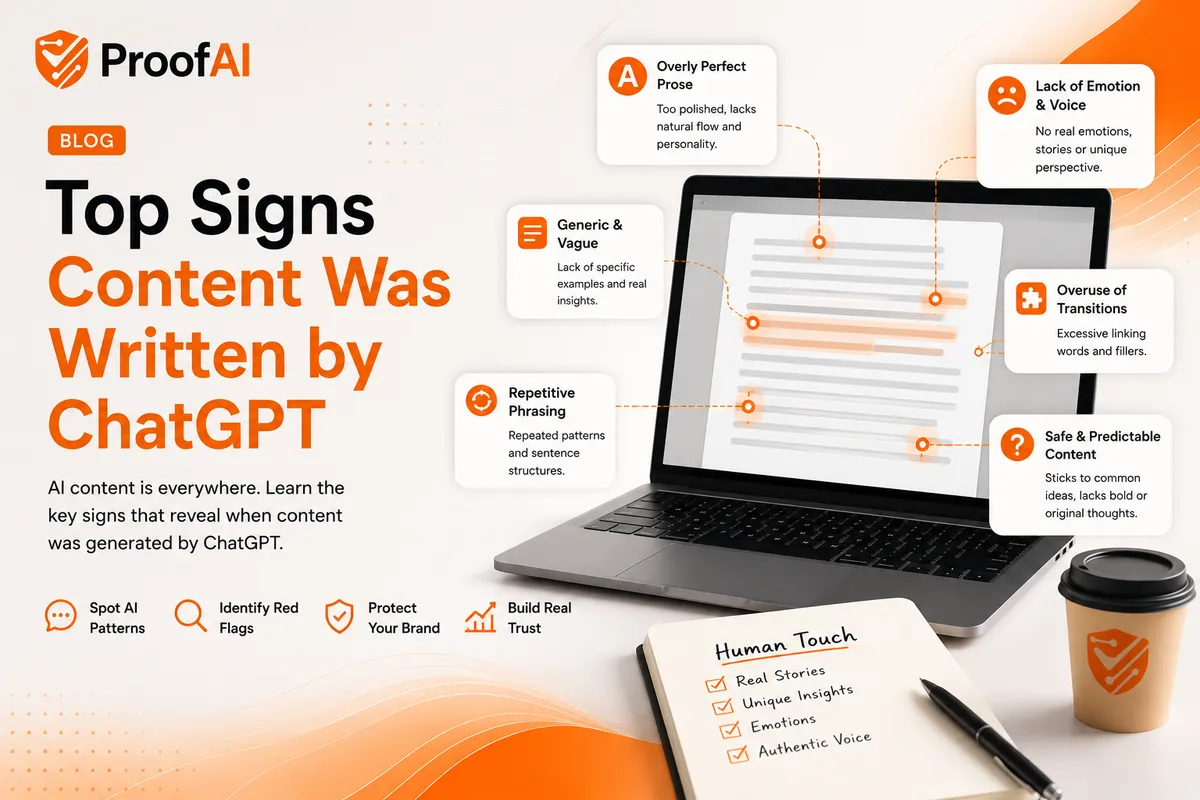
Signs Content Was Written by ChatGPT (and Their Limits)
Practical signs that text may be ChatGPT-written, how to check them, and why no single sign or detector score proves authorship.
Most people can sense when a piece of writing feels generated: correct, smooth, and somehow empty. Turning that feeling into something you can check is harder.
Below are the signs editors, teachers and reviewers most often rely on, how to test each one, and the limits you need to keep in mind before you accuse anyone.
Try it: use ProofAI's ChatGPT checker, free for 10 checks a day with no login.
First, a warning about "signs"
None of these signs proves AI authorship. Human writers use formal transitions, write generic introductions and make factual mistakes. Some groups are more likely to be misjudged than others.
A Stanford study published in Patterns found that seven popular AI detectors flagged essays by non-native English speakers as AI-generated at an average false positive rate of 61.3%, across 91 TOEFL essays (Times Higher Education). Human readers looking for "too plain" or "too correct" English can make the same mistake.
Treat the signs below as reasons to look closer, not conclusions.
1. Inflated claims of importance
Generated text often tells you why something matters instead of showing it. Wikipedia editors, who have been cleaning up AI-written submissions since 2023, list this as a common tell in their "Signs of AI writing" guide. They point to phrases like "a pivotal moment" or "a broader movement" (TechCrunch on Wikipedia's guide).
Want to check your own content? Try ProofAI free 10 checks a day, no login needed.
How to check: Delete every sentence that only asserts significance. If little real information is left, the piece is thin, whoever wrote it.
2. Vague clauses tacked onto the end of sentences
The same guide describes trailing phrases that add a sense of weight without content, such as "emphasizing the significance" or "reflecting the continued relevance."
How to check: Read the last few words of each sentence. If many end in a "-ing" clause that could be cut without losing meaning, that is a pattern worth noting.
3. Promotional tone where none is needed
Wikipedia's editors say some AI text "sounds more like the transcript of a TV commercial." You see this in product pages, but also in essays and reports that should be neutral.
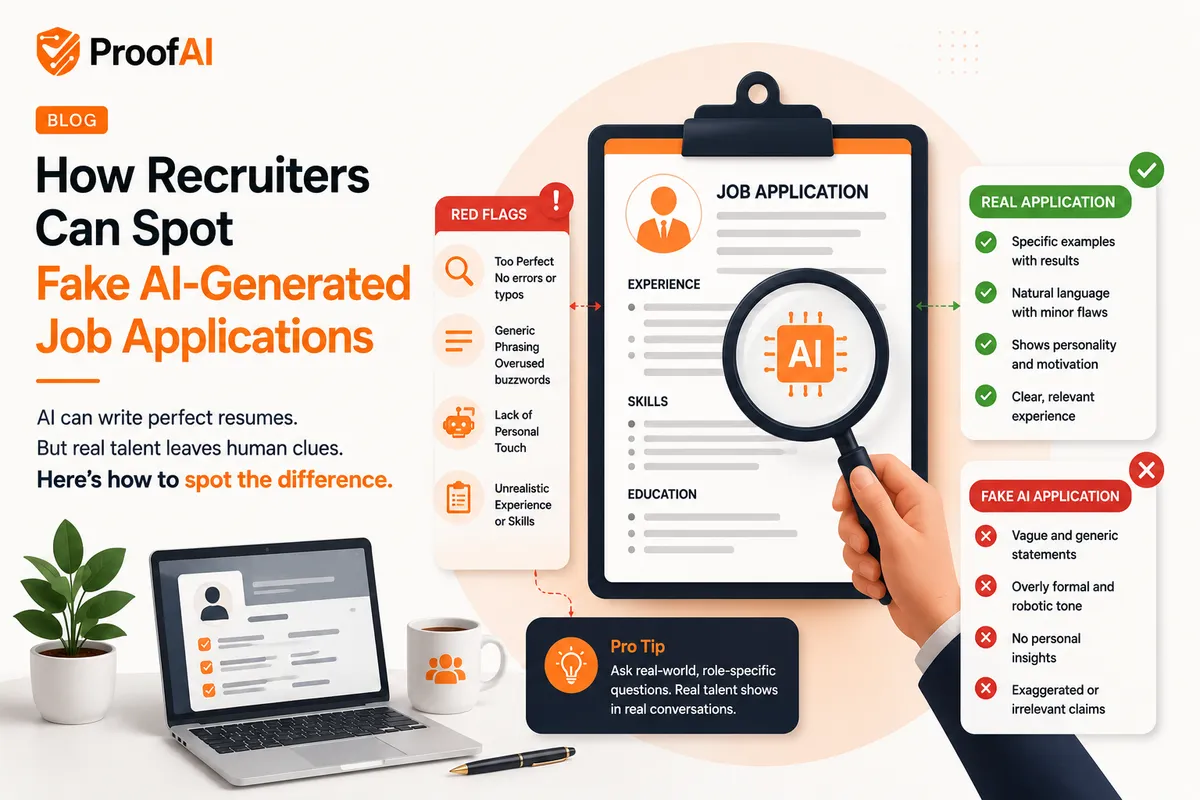
Also read: How to Detect AI-Written Resumes and Job Applications
How to check: Count adjectives that praise rather than describe ("seamless", "robust", "cutting-edge"). Ask whether each one is backed by a specific fact.
4. General statements with no specific detail
ChatGPT is good at summarising common knowledge. It is weaker at the specific: a named person, a date, a number with a source, a personal observation, a local example.
How to check: Look for at least one detail that only someone who did the work would know. A student essay that never mentions the course readings, or a case study with no names, dates or figures, deserves a closer look.
5. Uniform structure and rhythm
Generated drafts often repeat a template: an opening sentence, three supporting points, a summary line. Paragraphs come out at similar lengths, and lists appear in threes.
How to check: Skim the shape of the text. Real writing is usually uneven; some sections run long because the writer cared about them.
6. Confident but false facts and citations
This is the most useful sign, because you can verify it. Language models can produce references that look real but do not exist.
In Mata v. Avianca, a US federal judge fined two New York lawyers and their firm $5,000 in June 2023 after they filed a brief citing six non-existent court opinions generated by ChatGPT (Bloomberg Law).
How to check: Look up every citation. Confirm the paper, case or article exists, and that it says what the text claims. A fabricated source is concrete evidence; a smooth writing style is not.
7. Leftovers from the chat window
Sometimes text is pasted straight from a chatbot. Look for phrases addressed to the person who asked, such as an offer to "expand on any section", or a stray heading format that does not match the rest of the document.
How to check: Search the document for second-person sign-offs and for formatting that looks copied from another interface.
How to combine the signs
One sign means little. Several together, plus something verifiable, is a stronger basis for a conversation.
- Start with verifiable checks: citations, facts, quotes and dates.
- Compare with known writing: earlier work from the same student, employee or freelancer.
- Ask about the process: drafts, notes, sources, version history.
- Use a detector as one more input, knowing its limits. OpenAI withdrew its own AI text classifier in July 2023 because of low accuracy, and noted that AI-written text "can be edited to evade the classifier" (OpenAI).
- Decide on evidence, not on a feeling or a percentage.
If you are the writer
If you are worried your own work reads as generated, the fixes are the same as good editing: add specific examples, cite real sources, cut sentences that only claim importance, and let your structure follow your argument rather than a template.
Checking a passage
If you want a second opinion on a passage, ProofAI's ChatGPT text checker accepts text of 50 words or more and highlights the passages that drove its score. It gives 10 free checks a day without an account. As with any detector, the result is a probability, not proof.
Sources
- Times Higher Education on Liang et al., Patterns (11 July 2023): https://www.timeshighereducation.com/node/727071
- TechCrunch, "The best guide to spotting AI writing comes from Wikipedia" (20 November 2025): https://techcrunch.com/2025/11/20/the-best-guide-to-spotting-ai-writing-comes-from-wikipedia/
- Bloomberg Law, "Phony ChatGPT Brief Leads to $5,000 Fine for NY Lawyers" (22 June 2023): https://news.bloomberglaw.com/bgov-labor/chatgpt-phony-legal-filing-case-gets-lawyers-a-5-000-fine
- OpenAI, "New AI classifier for indicating AI-written text" (with July 2023 update): https://openai.com/index/new-ai-classifier-for-indicating-ai-written-text/
Written and reviewed by the 4Born Content Writer Team. AI tools assisted with drafting; every statistic above links to its source.
Published by
AI tools may assist with drafting; a team member checks and approves every article before it is published. How we write and correct articles.

Popular AI detection tools
Ready to Verify Your Content?
Get weekly insights on AI detection. Start your journey toward digital authenticity with our AI detection tools.