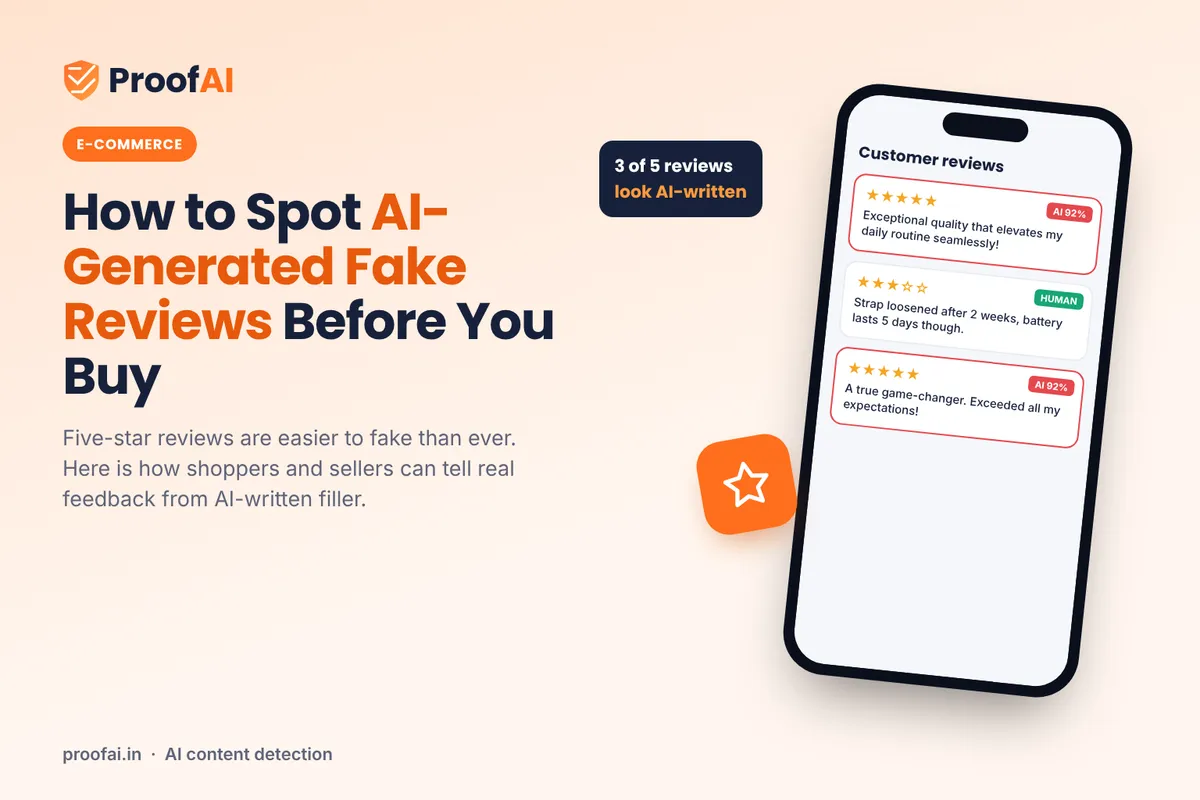
How to Spot AI-Generated Fake Reviews Before You Buy
Practical signs of AI-written fake reviews, what India's IS 19000:2022 and the US FTC rule say, and how shoppers and sellers can respond.
Fake reviews are not new. What has changed is that AI chatbots can write fluent, believable reviews in seconds, in any tone, for any product. The clumsy giveaways shoppers used to rely on, such as broken grammar or copy-pasted text, are less reliable now.
This guide covers what regulators say, the signs worth checking, and what sellers and platforms can do.
Try it: use ProofAI's free ChatGPT checker, free for 10 checks a day with no login.
What the rules say
Regulators have started naming AI-written reviews directly.
United States. In August 2024 the Federal Trade Commission announced a final rule banning fake reviews and testimonials. It covers reviews that misrepresent that they are by someone who does not exist, and the FTC gives "AI-generated fake reviews" as an example. The rule also bars paying for reviews that must express a particular sentiment, and insider reviews that do not disclose the reviewer's connection to the business. In December 2025, FTC staff warned 10 companies about possible violations and noted civil penalties of up to $53,088 per violation (the figure in the December 2025 letters).
India. The Department of Consumer Affairs and the Bureau of Indian Standards introduced IS 19000:2022, "Online Consumer Reviews — Principles and Requirements for their Collection, Moderation and Publication". The norms took effect on 25 November 2022, and compliance was voluntary at first. The standard applies to platforms that publish consumer reviews and includes verifying review authors and moderating reviews both automatically and manually. In February 2023 the ministry announced a conformity assessment scheme under which a platform's review processes can be certified against the standard.
Eight signs a review may be AI-written
No single sign proves anything. Several together are a reason to give the review less weight.
Want to check your own content? Try ProofAI free 10 checks a day, no login needed.
- It reads like an advert. Lines such as "seamlessly elevates your daily routine" sound like product copy, not a customer.
- No concrete details. Real buyers mention sizes, delivery times, how long the battery lasted, or what broke.
- It could describe any product. Swap the product name for another. If the review still works, it tells you nothing.
- Repeated phrasing across reviews. Several reviews with the same unusual wording may come from one prompt.
- Bursts on the same day. Many five-star reviews landing at once, especially on a new listing, deserve a closer look.
- Thin reviewer history. New accounts, or accounts that only ever post perfect ratings.
- Praise for features the product does not have. AI text can invent details that sound plausible.
- Polished but personality-free. Genuine reviews often include slang, typos or Hindi-English mixing. Perfect, neutral prose is not proof of AI, but it is worth noting alongside other signs.
A quick test: two reviews of the same smartwatch
These two reviews are illustrative examples written for this article, not real customer reviews.
Also read: EU AI Act Article 50: AI Transparency Rules Explained
"This smartwatch exceeded my expectations. Its sleek design and seamless features make it a perfect companion for everyday life. Highly recommended!"
"Strap felt loose after two weeks so I punched an extra hole. Battery lasts about five days with notifications on. Sleep tracking is hit and miss."
The first could be about any watch, or any product at all. The second is slightly messy and specific. That is what most real reviews look like.
Tips for shoppers
- Sort by most recent and by lowest rating. Critical reviews are harder to fake and usually more useful.
- Look for buyer photos and videos rather than studio images.
- Check the rating spread. Most real products get a mix of ratings. A listing with almost nothing but five stars deserves caution.
- Look for a verified purchase label, where the platform provides one.
- Read the reviewer's other reviews. A string of five-star reviews posted on the same day for unrelated products is a warning sign.
- Report suspicious reviews to the platform, so its moderators can investigate.
What sellers and platforms can do
Verify who is reviewing
IS 19000:2022 describes authenticating review authors, for example by email, phone or SMS. Accepting reviews only from confirmed buyers, and labelling them, gives shoppers a clear trust signal.
Moderate in layers
The standard expects both automated and manual moderation. Automated checks, including AI text detection, can sort new reviews so human moderators look at the most suspicious ones first. Detection is a triage step. A human should decide what gets removed.
Watch patterns, not just text
Sudden spikes, clusters of new accounts and shared phrasing often reveal coordinated campaigns more reliably than any single review.
Do not buy or write your own
Do not buy reviews, ask staff to post them without disclosure, or use AI to write "customer feedback" for your own products. The FTC rule explicitly covers several of these practices, and a batch of fakes that gets exposed can do more damage than a few honest three-star ratings.
Checking a suspicious review
If you want a second opinion on a long review or a batch of similar ones, paste the text into ProofAI's text detector. It needs at least 50 words, which suits longer reviews more than one-line ones, and it highlights the passages that drove the score. Platforms can integrate text checks through its REST API, which checks one piece of content per call. Treat the result as a probability that guides a human decision, not proof.
Sources
- US Federal Trade Commission, Federal Trade Commission Announces Final Rule Banning Fake Reviews and Testimonials (14 August 2024)
- US Federal Trade Commission, FTC Warns 10 Companies About Possible Violations of the Agency's New Consumer Review Rule (22 December 2025)
- Ministry of Consumer Affairs, Food and Public Distribution (PIB release), Conformity assessment scheme for IS 19000:2022 (15 February 2023)
- Moneylife, Government Unveils Framework To Prevent Fake Reviews of Products
- Gala Law, Framework launched by the Government of India to restrict fake reviews on e-commerce
Written and reviewed by the 4Born Content Writer Team. AI tools assisted with drafting; every statistic above links to its source.
Published by
AI tools may assist with drafting; a team member checks and approves every article before it is published. How we write and correct articles.

Popular AI detection tools
Ready to Verify Your Content?
Get weekly insights on AI detection. Start your journey toward digital authenticity with our AI detection tools.