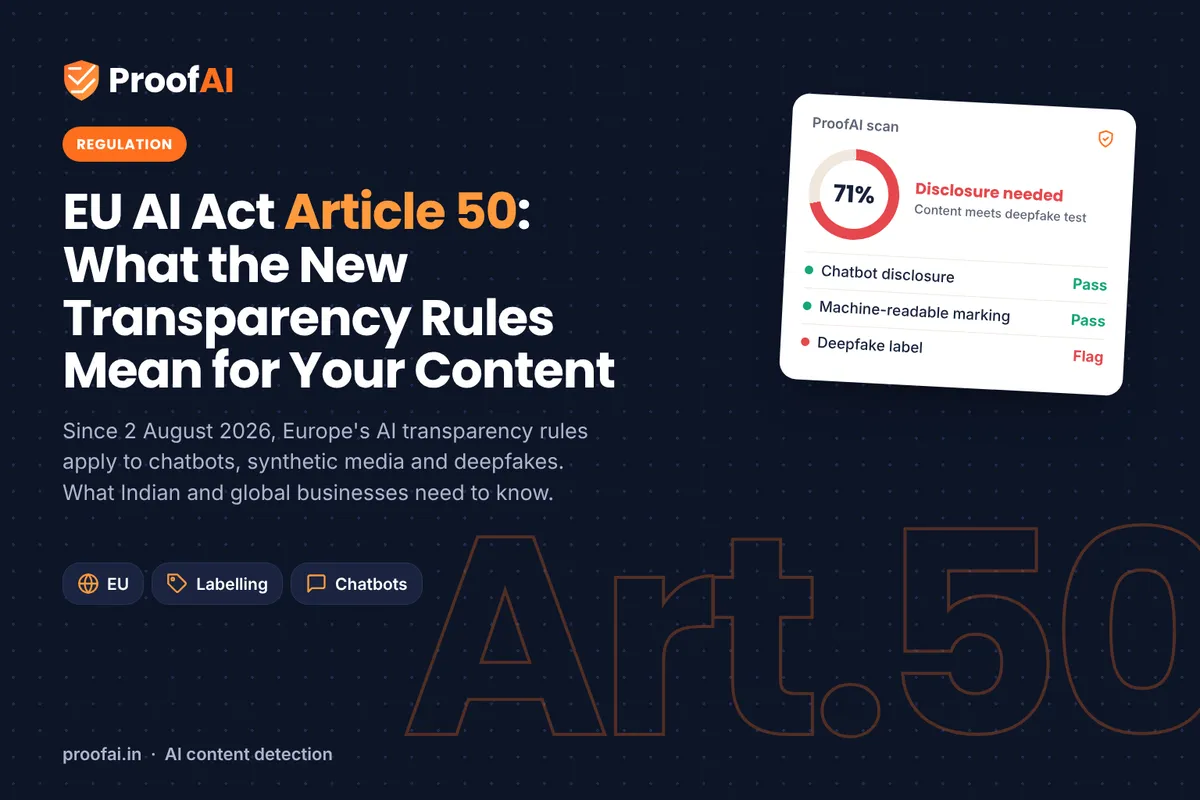
EU AI Act Article 50: AI Transparency Rules Explained
Article 50 of the EU AI Act has applied since 2 August 2026. What it requires for chatbots, AI content and deepfakes, and the 2 December 2026 deadline.
Article 50 of the EU AI Act sets out when people must be told they are dealing with AI, and when AI-generated content must be marked or labelled. These obligations have applied since 2 August 2026, according to the European Commission's Article 50 FAQ.
The rules reach beyond Europe. The Commission says providers outside the EU are covered if their AI system's output is used in the EU. So an Indian SaaS company with European users, or an agency producing campaigns for EU clients, should read this closely.
Try it: use ProofAI's AI detector tool, free for 10 checks a day with no login.
This is a plain-language summary, not legal advice.
The four main duties
The Commission's FAQ and the Future of Life Institute's guide break Article 50 down as follows.
1. Tell people they are talking to AI (Article 50(1), providers). Chatbots and other systems that interact directly with people must make this clear from the first interaction, unless it is obvious. The Commission's FAQ says obviousness is judged from the position of an average, reasonably well-informed, circumspect and observant person.
2. Mark AI output in a machine-readable way (Article 50(2), providers). Systems that generate synthetic audio, images, video or text must mark their output so it can be detected as AI-generated. Exemptions include assistive standard editing, such as grammar correction, and systems that do not substantially change the input.
3. Inform people about emotion recognition or biometric categorisation (Article 50(3), deployers).
Also read: AI Detector False Positives: Why Human Writing Gets Flagged
4. Disclose deepfakes and certain AI text (Article 50(4), deployers). If you publish a deepfake, you must disclose it. If you publish AI-generated or AI-manipulated text to inform the public on matters of public interest, you must also disclose it, unless the text went through human review or editorial control and someone holds editorial responsibility.
A "provider" builds an AI system and offers it under its own name. A "deployer" uses one in a professional capacity. Purely personal use is excluded (Commission FAQ). Most businesses that use generative AI for marketing are deployers.
What counts as a deepfake
The AI Act defines a deepfake in Article 3(60) as AI-generated or manipulated image, audio or video content that resembles existing persons, objects, places, entities or events and would falsely appear to a person to be authentic or truthful (AI Act Service Desk).
Want to check your own content? Try ProofAI free 10 checks a day, no login needed.
The Commission's FAQ sets out how deployers must disclose deepfakes:
- Disclosure must happen at first exposure at the latest, in a clear and distinguishable manner.
- It must be perceivable without specific technical tools or dedicated actions, for example through visible or audible labels.
- Deployers cannot simply rely on the machine-readable marking the provider embedded under Article 50(2).
- For evidently artistic, creative, satirical or fictional works, the duty is limited to disclosing the deepfake content in an appropriate manner that does not spoil the work.
The Commission adopted its final guidelines on 20 July 2026. Re-check the final text against these points, and for any detail not covered here, before you build processes on them.
Timeline: what applies now
| Date | What happened | Status |
|---|---|---|
| 10 June 2026 | Commission published the voluntary Code of Practice on marking and labelling AI-generated content | Published; assessed as adequate by the Commission and AI Board, per the FAQ |
| 20 July 2026 | Commission adopted guidelines on Article 50 | Adopted |
| 24 July 2026 | Digital Omnibus on AI, Regulation (EU) 2026/1744, published in the Official Journal | In force, per Cuatrecasas |
| 2 August 2026 | Article 50 obligations apply | In force |
| 2 December 2026 | Deadline for Article 50(2) marking for generative AI systems placed on the market before 2 August 2026 | Upcoming |
The four-month grace period applies only to the machine-readable marking duty, and only to systems already on the market before 2 August 2026. Everything else, including deepfake disclosure and chatbot notices, already applies (Commission FAQ). Content created before 2 August 2026 does not have to be labelled retroactively.
Penalties
Under Article 99(4), breaching Article 50 transparency duties can lead to fines of up to EUR 15 million or 3% of worldwide annual turnover, whichever is higher. For SMEs, including start-ups, and for small mid-cap companies, the lower of the two applies (AI Act Service Desk, Article 99).
How to prepare your content workflow
- Map your AI use. List every chatbot, voice tool and generator your team uses, and note whether you are the provider or the deployer.
- Add chatbot disclosures at the start of every conversation, not in a footer.
- Label realistic synthetic media that shows real-looking people, places or events.
- Decide your editorial process for AI text. If public-interest articles are AI-assisted, document the human review and who holds editorial responsibility.
- Keep the marks your tools add. Avoid workflows that strip metadata, such as screenshotting or re-exporting through tools that discard it.
- Check third-party content from agencies, freelancers and user submissions.
- Keep records of what was labelled and why.
Marking and detection work together
Machine-readable marks only exist if the generating tool adds them, and they can be lost through editing, screenshots or re-encoding. When a file reaches you with no provenance data, content-based detection is a reasonable second check, provided you treat it as a likelihood, not proof.
ProofAI's AI text detector checks text of 50 words or more and highlights the passages that drove the score, which helps an editor decide what needs a closer human review. The REST API can add the same check to a CMS or moderation queue; ProofAI scores are probabilities, not legal determinations.
Sources
- European Commission, Transparency obligations under Article 50 AI Act (FAQ) (updated 24 July 2026)
- European Commission, Guidelines on transparency obligations for providers and deployers of AI systems (20 July 2026)
- European Commission, Commission publishes Code of Practice on marking and labelling AI-generated content (10 June 2026)
- AI Act Service Desk, Article 3: Definitions
- AI Act Service Desk, Article 99: Penalties
- Official Journal of the European Union, Regulation (EU) 2026/1744 of the European Parliament and of the Council of 8 July 2026 (Digital Omnibus on AI), published 24 July 2026
- Cuatrecasas, Digital Omnibus on AI has been published (24 July 2026)
- Future of Life Institute, The EU AI Act's transparency rules: a practical guide to Article 50 (14 May 2026)
Written and reviewed by the 4Born Content Writer Team. AI tools assisted with drafting; every statistic above links to its source.
Published by
AI tools may assist with drafting; a team member checks and approves every article before it is published. How we write and correct articles.
Popular AI detection tools
Ready to Verify Your Content?
Get weekly insights on AI detection. Start your journey toward digital authenticity with our AI detection tools.