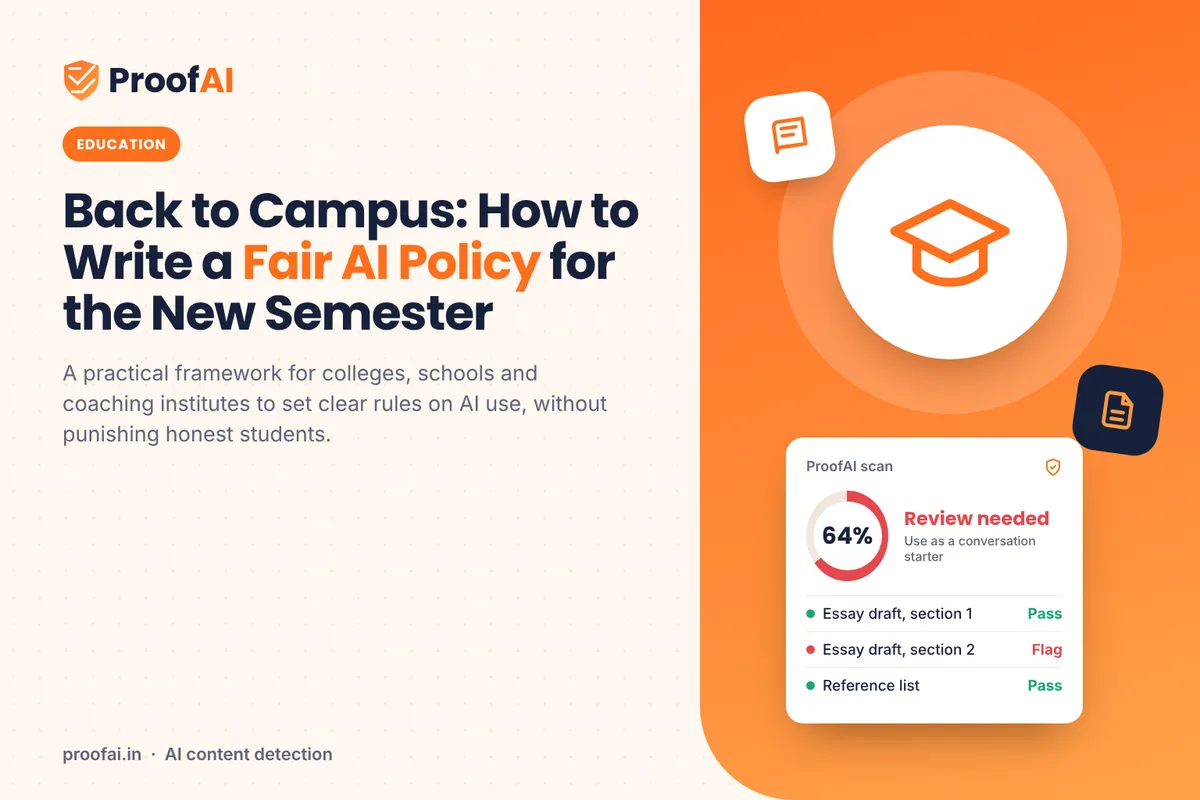
How to Write a Fair AI Policy for the New Semester
A practical guide for colleges and schools: AI use zones, disclosure, using detectors fairly, and a review process for flagged work. Includes a template.
Students arrive each semester already using ChatGPT, Gemini, Claude and similar tools. Banning them outright is hard to enforce, and ignoring them leaves every suspected case to be argued from scratch. A short written policy, agreed before the first assignment, is fairer to students and easier for staff.
Why write the policy now
Many institutions had nothing written down when generative AI arrived. A 2023 UNESCO survey of over 450 schools and universities found that fewer than 10% had institutional policies or formal guidance on generative AI. That figure is dated, but the gap it describes is why a short written policy is worth having. UNESCO's Guidance for generative AI in education and research sets out measures to develop "coherent, comprehensive policy frameworks", and in its press release UNESCO called on governments to implement regulations and teacher training.
Try it: use ProofAI's AI detector tool, free for 10 checks a day with no login.
A written policy does three things:
- It tells students the rules before anyone is flagged.
- It keeps decisions consistent across departments and teachers.
- It gives the institution a documented process if a decision is challenged.
Know the limits of AI detectors first
Any policy that mentions detection should be written with the evidence on accuracy in mind.
Want to check your own content? Try ProofAI free 10 checks a day, no login needed.
- Detectors can be wrong, in both directions. OpenAI withdrew its own AI text classifier on 20 July 2023 because of its low rate of accuracy. In OpenAI's evaluation on a "challenge set" of English texts, it correctly flagged about 26% of AI-written text and wrongly labelled about 9% of human-written text as AI. It was also very unreliable on texts under 1,000 characters.
- Non-native English writers face a higher risk of false flags. A Stanford study by Liang and colleagues, published in Patterns in 2023, tested seven detectors on 91 TOEFL essays written by people. The detectors wrongly flagged an average of 61.22% of them as AI-generated, and 89 of the 91 were flagged by at least one detector. The authors caution against using detectors in evaluative or educational settings without care.
Detection tools have kept changing since 2023, but even Turnitin's guidance says its AI score "should not be used as the sole basis for action or a definitive grading measure by instructors", so the lesson holds. In India, where many students write in their second or third language, a score alone must never decide a case.
Five building blocks of a fair policy
1. Define three zones of use
- Allowed: for example brainstorming, checking grammar, or explaining a concept.
- Allowed with disclosure: for example summarising sources or restructuring a draft.
- Not allowed: for example generating the submitted answer, essay or code.
Let each course adjust the zones. A creative writing class and a programming lab need different rules, so state the zone on every assignment brief.
Also read: EU AI Act Article 50: AI Transparency Rules Explained
2. Ask for a one-line disclosure
Ask students to note which tools they used and for what. "Used ChatGPT to check grammar in sections 2 and 3" is enough. Never penalise an honest disclosure of allowed use, or students will stop disclosing.
3. Use detection to check, not to accuse
A detection result can start a conversation. It cannot finish one. Write this into the policy in plain words so students and staff both know it.
4. Talk before deciding
When work is flagged, meet the student. Ask them to explain their argument, walk through a paragraph, or show drafts and notes. Students who wrote their own work can usually do this easily.
5. Apply it consistently
Publish the policy, brief all faculty in the first week, and use the same review steps for every case.
A four-step review for flagged work
- Scan. Check the full submission, not an extract. Short answers are hard to classify reliably, so be more cautious with them.
- Review. Read the highlighted passages. Compare them with the student's earlier work and anything written in class.
- Discuss. Meet the student and ask open questions about how they produced the work.
- Decide and record. Note the outcome and the reasons, with reference to the written policy.
A template you can adapt
AI use in this course You may use AI tools to brainstorm, check grammar and understand concepts. Any other use must be disclosed in one line at the end of your submission. The final argument, analysis and writing must be your own. We may use AI detection tools. A detection result is never enough on its own: if your work is flagged, we will talk with you before any decision is made, and you can show drafts or notes. If you are unsure whether a use is allowed, ask before you submit.
Mistakes to avoid
- Treating a high score as a verdict.
- Changing the rules mid-semester.
- Relying on detection for very short answers.
- Using detectors without training staff to read the results.
- Writing a policy that only covers essays and forgets code, slides and lab reports.
Where a detector fits
ProofAI for Indian universities lets teachers upload PDF, DOCX, DOC or TXT files up to 25 MB, or paste text of 50 words or more, and shows the passages that drove each score. Anyone can run 10 free checks a day without an account, or 25 with a free account. As with any detector, ProofAI gives a probability, not proof, so use it at step one of the review above and let the conversation decide.
ProofAI sends the text or files you check to AI model providers to analyse them and keeps a record of each check (date, type and score, never your content); see our privacy policy.
Sources
- UNESCO, UNESCO: Governments must quickly regulate Generative AI in schools (7 September 2023)
- UNESCO, Guidance for generative AI in education and research (7 September 2023)
- OpenAI, New AI classifier for indicating AI-written text (update of 20 July 2023)
- Turnitin, AI writing detection capabilities FAQs
- Liang, W., Yuksekgonul, M., Mao, Y., Wu, E., Zou, J., GPT detectors are biased against non-native English writers, Patterns, 2023 (full text)
Written and reviewed by the 4Born Content Writer Team. AI tools assisted with drafting; every statistic above links to its source.
Published by
AI tools may assist with drafting; a team member checks and approves every article before it is published. How we write and correct articles.

Popular AI detection tools
Ready to Verify Your Content?
Get weekly insights on AI detection. Start your journey toward digital authenticity with our AI detection tools.