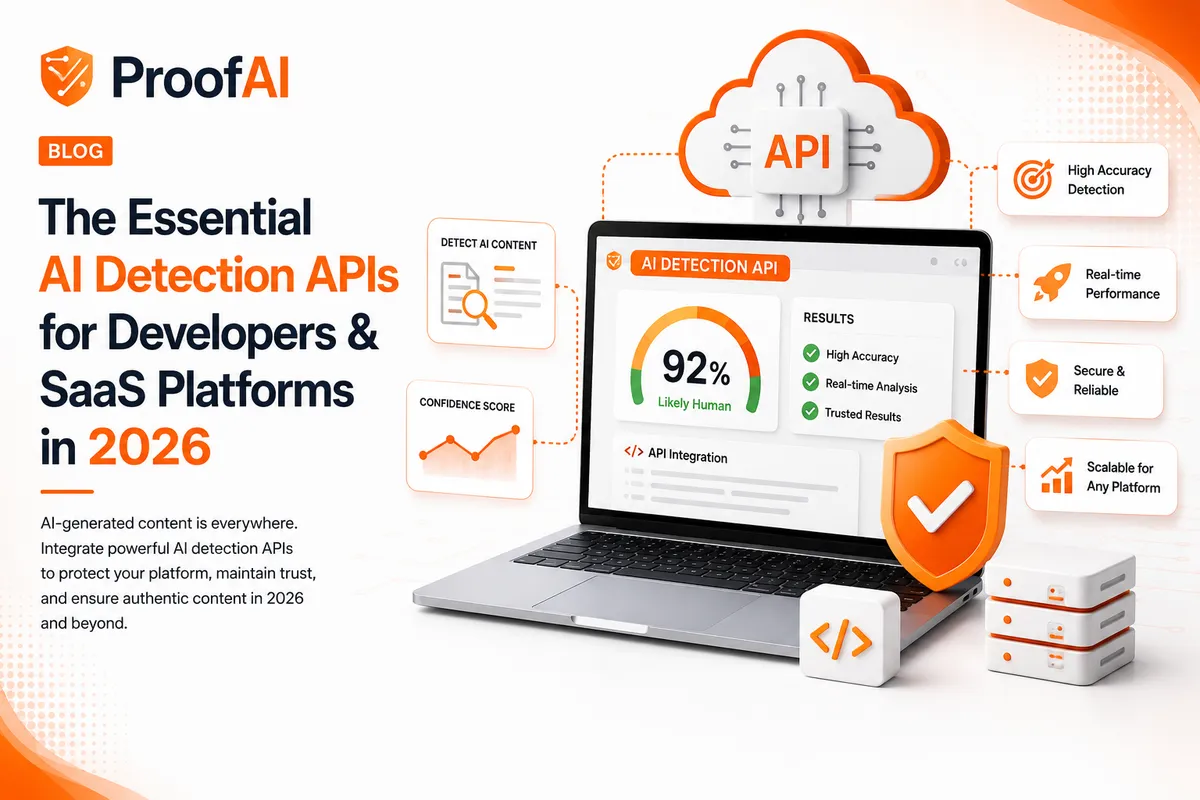
Choosing an AI Detection API: A Developer's Checklist
How to evaluate an AI detection API for your SaaS or platform: accuracy data, limits, response format, pricing, privacy and integration patterns.
There is no single "best" AI detection API. The right choice depends on what you are checking (essays, reviews, support tickets, files), how fast you need an answer, and what you will do with the result.
This guide gives you a checklist for evaluating any provider, shows how a few providers document their APIs, and covers integration patterns that avoid the most common mistakes.
Try it: use ProofAI's AI detector tool, free for 10 checks a day with no login.
Start with what you will do with the score
Decide this before comparing vendors. A detector returns a probability, and providers say so themselves. Sapling's docs state plainly that "all AI detection systems have false positives and false negatives" (Sapling). OpenAI's own classifier correctly flagged only 26% of AI-written text in its tests and was withdrawn in July 2023 "due to its low rate of accuracy" (OpenAI).
So design for one of these outcomes:
- Flag for human review (education, hiring, publishing). Safe for most uses.
- Add friction (rate limiting, extra verification) for spam or bulk content.
- Report only (dashboards, audits).
Avoid automatic penalties based on a score alone. Turnitin's guidance warns its score "should not be used as the sole basis for action" (Turnitin FAQ).
Evaluation checklist
1. Published accuracy, broken down. Ask for false positive and false negative rates separately, the dataset used, text lengths, languages and the date measured. Be wary of one headline number.
Want to check your own content? Try ProofAI free 10 checks a day, no login needed.
2. Bias testing. Ask whether the provider has tested on non-native English writing. A Stanford study found seven detectors gave an average false positive rate of 61.3% on 91 TOEFL essays (Times Higher Education). If your users write in English as a second language, this matters more than anything else on the list.
3. Granularity. A single score is hard to act on. Sentence or segment scores let a reviewer see what drove the result and let you build highlighting into your UI.
4. Input limits. Check minimum and maximum lengths, supported file types and size caps. Short inputs, such as one-line comments, are where detectors are least reliable.
5. Languages. Confirm which languages are supported, not just accepted.
6. Latency and rate limits. Know the per-minute limit and what the 429 response looks like, and plan a queue or backoff.
Also read: How to Screen AI-Written Job Applications Fairly
7. Pricing model. Per request, per word, credits, or subscription. Check what happens when you run out: hard stop or automatic charge.
8. Data handling. Where is text stored, for how long, and is it used to train models? This is especially important for student work and client documents.
9. Versioning. Can you pin a model version, so scores do not shift silently after an update?
How some providers document their APIs
These details come from each provider's official documentation as read on 17 October 2026. Check the current docs before building, as they change.
Sapling. POST https://api.sapling.ai/api/v1/aidetect with a 32-character API key. It returns an overall score from 0 to 1, optional per-sentence scores, and optional token-level probabilities. The docs note that the overall score "is computed over the whole text at once, so it is not the plain average of the sentence scores." Text is limited to 200,000 characters, and you can pass a version parameter to choose a model version (Sapling).
Originality.ai. Requests are authenticated with an X-OAI-API-KEY header. The docs list endpoints for single scans, batch scans, URL scans and credit balance, and give a rate limit of 500 requests per minute, with a 429 error above that. Accounts are set to top up credits automatically by default, which you may want to change before load testing (Originality.ai docs).
We have not independently benchmarked the accuracy of these APIs and make no claims about it.
Integration patterns
Submission pipeline. Run the check asynchronously after upload, store the score and segments with the submission, and show them to a reviewer, not to an automated grader.
Pre-publication check. For CMS or marketplace content, flag high scores for an editor before publishing.
Moderation queue. Combine the score with other signals, such as account age, posting rate and duplicate content. A detector score alone is a weak spam signal on short text.
Audits. Sample existing content periodically and track trends rather than individual results.
Whatever the pattern, store the model version and the timestamp with each score, so you can explain a result later.
Example request
Our own API is a REST endpoint authenticated with an x-api-key header and an Origin header matching your key's domain. A minimal detection request, as documented in the API docs:
curl -X POST https://ai.proofai.in/api/v1/detect \
  -H "x-api-key: YOUR_API_KEY" \
  -H "Origin: YOUR_DOMAIN" \
  -H "Content-Type: application/x-www-form-urlencoded" \
  -d "content=The text you want to analyze goes here."
The documented response includes ai_probability, human_probability, a verdict such as "Likely AI", a model_version, and a segments array with per-segment probabilities. The docs recommend at least 50 words of content, and a 429 status means the quota is exceeded.
Getting started
Shortlist two or three providers, run the same test set through each (including human writing from your real users), and compare false positives first. If you want to include ProofAI, plans are priced in INR and the API platform page has the details. Its results are probabilities, not proof, so build a human review step into your flow either way. ProofAI sends the text or files you check to AI model providers to analyse them and keeps a record of each check (date, type and score, never your content); see our privacy policy.
Sources
- Sapling, AI Detector API documentation: https://sapling.ai/docs/api/detector/
- OpenAI, "New AI classifier for indicating AI-written text": https://openai.com/index/new-ai-classifier-for-indicating-ai-written-text/
- Turnitin, "AI writing detection capabilities FAQs": https://guides.turnitin.com/hc/en-us/articles/28477544839821-Turnitin-s-AI-writing-detection-capabilities-FAQs
- Times Higher Education on Liang et al., Patterns (11 July 2023): https://www.timeshighereducation.com/node/727071
- Originality.ai API documentation index: https://docs.originality.ai/llms.txt
- API documentation: https://proofai.in/api-docs
Written and reviewed by the 4Born Content Writer Team. AI tools assisted with drafting; every statistic above links to its source.
Published by
AI tools may assist with drafting; a team member checks and approves every article before it is published. How we write and correct articles.


Popular AI detection tools
Ready to Verify Your Content?
Get weekly insights on AI detection. Start your journey toward digital authenticity with our AI detection tools.